
One Big Beautiful Bill: Changes in the Tax Landscape

The One Big Beautiful Bill Act (OBBBA), enacted July 4, 2025, changed the tax rules for families, business owners and investors. Some provisions preserve deductions that were scheduled to expire. Others introduce temporary benefits, increase the amount businesses can deduct upfront, or end credits sooner than expected. [17]
The practical question is how those changes affect your return and your next financial decision. This overview focuses on the federal provisions most likely to matter to NMA's individual and business clients, with particular attention to the 2026 tax year.
What individuals and families should know
Tax rates and a larger standard deduction
The law made the individual tax rate structure introduced by the Tax Cuts and Jobs Act permanent, with rates ranging from 10% to 37%. It also preserved and increased the larger standard deduction. For 2026, the basic standard deduction is $16,100 for single taxpayers and married taxpayers filing separately, $32,200 for married couples filing jointly, and $24,150 for heads of household. Additional amounts may apply for age or blindness. [1, 2, 17]
A higher state and local tax deduction cap
For taxpayers who itemize, the state and local tax (SALT) deduction cap is $40,400 in 2026, or $20,200 for married taxpayers filing separately. The cap begins decreasing when modified adjusted gross income exceeds $505,000, or $252,500 for separate filers. It cannot fall below $10,000, or $5,000 for separate filers. [2]
The higher cap may make itemizing worthwhile for households with significant property taxes and state income taxes. It remains temporary: the increased limits apply through 2029, with the cap scheduled to return to $10,000 in 2030, or $5,000 for separate filers. [3]
An increased Child Tax Credit
The maximum Child Tax Credit increased to $2,200 per qualifying child beginning in 2025, with inflation indexing thereafter. Children generally must be under age 17 at year-end. Income limits, Social Security number requirements and other eligibility rules still apply, and the entire credit is not automatically refundable. [4]
Four temporary deductions through 2028
Eligible taxpayers can claim the following deductions for tax years 2025 through 2028, even when they take the standard deduction. The amounts below are maximums before income phaseouts and other limits. MAGI means modified adjusted gross income. [5, 6, 7]
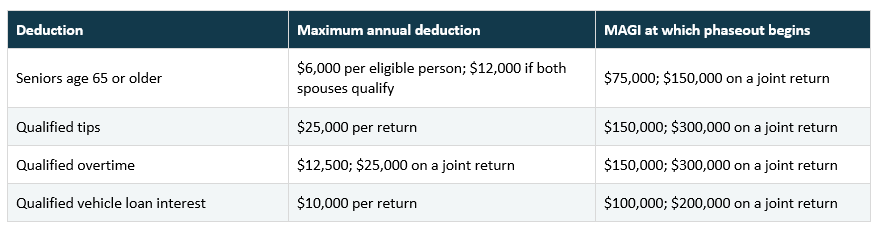
The details matter. The tips deduction applies to qualifying, reported tips in eligible occupations. The overtime deduction generally covers the premium required under the federal Fair Labor Standards Act, usually the extra half of time-and-a-half pay. It does not cover all wages earned during overtime hours. Payroll and self-employment tax rules continue to apply. [6]
The vehicle interest deduction generally requires a qualifying loan originated after 2024 to purchase a new vehicle for personal use with final assembly in the United States. Used vehicles and lease payments do not qualify. The senior deduction is separate from the existing additional standard deduction and does not change the rules governing the taxation of Social Security benefits. Married taxpayers must file jointly to claim the tips, overtime or senior deduction. [5, 7]
New rules for charitable giving
Beginning in 2026, taxpayers taking the standard deduction can deduct up to $1,000 of qualifying cash contributions, or $2,000 on a joint return. Donations to donor-advised funds do not qualify for this particular benefit. [8, 9]
For itemizers, charitable contributions are generally deductible only to the extent they exceed 0.5% of adjusted gross income, subject to other limits. A separate restriction also reduces the benefit of itemized deductions for taxpayers in the 37% bracket. Donation timing deserves a fresh look, especially when a large gift is planned. [2]
Family benefits and estate planning
Beginning in 2026, the maximum Child and Dependent Care Credit rate rises to 50% of qualifying expenses, with the actual rate depending on income. The qualifying expense limits remain $3,000 for one eligible individual and $6,000 for two or more. HSA eligibility also expands to include bronze and catastrophic health plans, subject to other eligibility requirements. [9]
The federal estate and gift tax basic exclusion increases to $15 million per person in 2026, with inflation adjustments thereafter. That creates additional planning capacity for families transferring substantial assets, although earlier taxable gifts can reduce the remaining exclusion. [1, 10]
Credits and subsidies that require extra attention
Federal new, used and commercial clean vehicle credits generally ended for vehicles acquired after September 30, 2025. The home energy improvement credit generally ended for property placed in service after December 31, 2025, and the residential clean energy credit ended for expenditures made after that date. A purchase made in 2026 should not be evaluated using older credit assumptions. [9]
Beginning with tax year 2026, repayment caps no longer protect taxpayers who received excess advance Premium Tax Credit payments for Marketplace health coverage. Updating the Marketplace when income or household circumstances change can help prevent an unexpected balance due. [11]
What business owners should know
The qualified business income deduction is permanent
The law made the Section 199A qualified business income (QBI) deduction permanent. Eligible owners of sole proprietorships, partnerships and S corporations can generally deduct up to 20% of qualifying business income. Income limits, wage and property restrictions, and special rules for certain service businesses still affect the calculation. Employee wages and C corporation income do not qualify. [2, 12]
More deductions when assets enter service
The OBBBA permanently restored 100% bonus depreciation for qualifying property generally acquired and placed in service after January 19, 2025. Eligible equipment and certain shorter-lived real estate components may qualify. Acquisition timing, binding contracts and other eligibility rules matter; a building's entire purchase price does not automatically qualify. [13]
Section 179 expensing limits also increased. For 2026, the maximum deduction is $2,560,000, and the dollar limit begins phasing out when qualifying property placed in service exceeds $4,090,000. Section 179 has a business income limitation and other restrictions, so it should be evaluated alongside bonus depreciation. Assets generally must be ready and available for their intended business use before a deduction begins. [14]
Immediate deductions for domestic research costs
For tax years beginning after 2024, Section 174A generally permits an immediate deduction for domestic research and experimental costs, including qualifying software development. Foreign research costs generally remain subject to 15-year amortization. Transition provisions address previously capitalized domestic costs, but elections, accounting methods and filing deadlines require separate review. [15]
Businesses developing products or software should revisit both their research expense treatment and any research credit analysis. An expense deduction and a tax credit have different qualification rules.
A more favorable business interest calculation
For tax years beginning after 2024, businesses subject to Section 163(j) can again add back depreciation, amortization and depletion when calculating adjusted taxable income. This can increase the amount of business interest deductible under the limitation. Real estate businesses should review the result alongside any election to avoid the interest limitation and the related depreciation consequences. [16]
Turn the changes into a plan
A larger deduction is useful only when it fits your circumstances. Before buying equipment, accelerating donations or changing an investment plan, consider your expected income, the timing of deductions and the effect on future years. State tax treatment may differ from the federal rules.
At Nathrop Maxwell Advisors, we help owners, investors and families evaluate how these provisions affect their tax position. Schedule a conversation to review the changes that matter to you and identify practical steps before year-end.
This article provides general information about federal tax law as of October, 2026. Eligibility and results depend on your circumstances and applicable guidance.
Sources
1. IRS 2026 tax inflation adjustments
2. IRS Publication 505 for 2026
3. Internal Revenue Code Section 164
5. IRS provisions for individuals and workers
6. IRS tips and overtime deduction overview
7. IRS guidance on vehicle loan interest
8. IRS charitable contributions overview
9. IRS overview of OBBBA provisions
10. IRS estate and gift tax changes
11. IRS advance Premium Tax Credit repayment changes
12. IRS qualified business income deduction
13. IRS bonus depreciation guidance
14. IRS Publication 946 on depreciation
15. IRS Internal Revenue Bulletin 2026 39 on research expenditures
16. IRS business interest limitation questions and answers
17. IRS Revenue Procedure 2025 32 and 2026 inflation updates